
Executive protocol — and why Japan teaches it differently
In September 1661, two ambassadors’ carriages collided in the streets of London. The dispute was between Spain’s envoy and France’s, over which coach would pass first. Men on both sides were killed. The matter didn’t end in the street: Louis XIV demanded, and received, a formal apology from Madrid — along with a standing concession that French ambassadors would take precedence over Spanish ones at every court in Europe, from then on. The outcome is still commemorated on the ceiling of the Hall of Mirrors at Versailles.
A carriage’s place in a procession. That was the entire dispute. Two great powers came within a step of war over it.
Most executives sense, at some level, that questions like this still matter — that where you sit, who goes first, who is greeted first, are never really neutral. What’s less clear is why they carry so much weight, and what to actually do about it in a boardroom rather than a royal court.
Protocol is not etiquette at a larger scale
Etiquette governs the space between individuals. It varies by culture, and no version of it is more “correct” than another — it isn’t meant to be judged that way.
Protocol governs the space between institutions and states, and its purpose is different: not elegance, but fairness. Its function is to remove discretion from questions of precedence so that no single reading of the room can be contested.
The 1961 Vienna Convention on Diplomatic Relations settled ambassadorial rank not by a nation’s power, wealth, or history, but by the date each ambassador presented credentials to the host state — a rule with no relationship to merit, deliberately. That’s the design. Precedence stops being a fight only once it stops being anyone’s judgment call.
The same structure governs which side visits the other first in an acquisition, who is seated closest to the principal at a signing, whose name appears first in a joint press release. Organizations without a standard leave each of these calls to the mood of the room on the day. What the mood decides, the mood can also lose.
Why the shape of a table stopped a war from ending
A more contemporary example makes the same point more sharply.
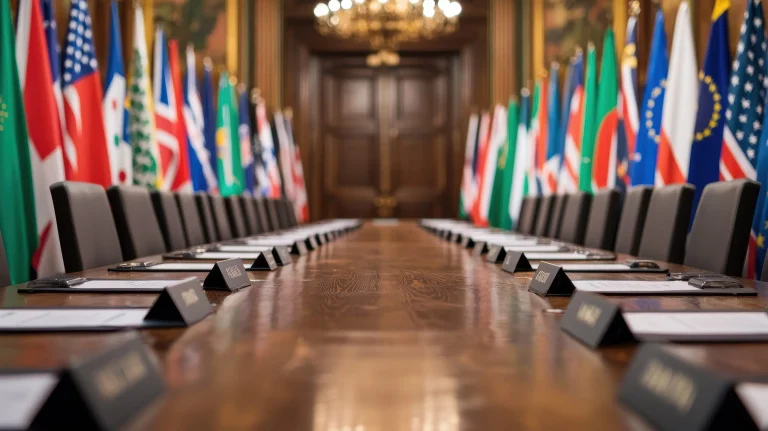
By May 1968, peace talks to end the Vietnam War had opened in Paris. By November, they had stalled completely — not over any clause of the eventual settlement, but over the shape of the negotiating table. Square, rectangular, oval: more than twenty configurations were proposed over roughly ten weeks. Calling this a waste of time is easy, but for the parties involved, it was the negotiation.
A four-sided table implies four recognized parties. A table with two facing sides implies two. Hanoi would not recognize Saigon’s government as legitimate; Saigon would not recognize the National Liberation Front as a party in its own right. The shape of the table wasn’t a preliminary to the real argument — it was the argument, about who was even entitled to be in the room.
The eventual solution, reached in January 1969, didn’t resolve that question. It sidestepped it: a round table 4.75 meters across, flanked by two rectangular tables for aides, no flags, no nameplates, speaking order alternating. Talks opened on January 18 — a week before Richard Nixon’s inauguration.
Form is not the decoration around substance. Form is the condition that makes substance possible at all.
This structure recurs, unchanged, in cross-border M&A, joint-venture launches, and first courtesy calls between firms from different countries. Who visits whom first. Who is at the door to greet the other side. Who speaks first at a joint press conference. An organization that hasn’t thought through these questions in advance has already ceded ground before the actual negotiation starts.
Executive presence: gravitas does the heavy lifting, but appearance is the gate
A widely cited study of 268 senior executives conducted by Sylvia Ann Hewlett — then chair of the Center for Talent Innovation — asked what actually constitutes “executive presence.” The breakdown: gravitas, 67%; communication, 28%; appearance, 5%.
That 5% figure is often cited to suggest appearance barely matters. That’s a misreading. Hewlett herself frames appearance as a filter: the threshold you have to clear before anyone evaluates your gravitas or your communication at all. Fail the filter, and the other two never get assessed on their merits. Appearance is a necessary condition for entry into the room. It was never the destination — which is exactly why polish alone, without what it’s meant to admit you to, falls short.
Once past that threshold, what actually carries the room is gravitas: composure under pressure, decisiveness, integrity, control of one’s own reactions. And gravitas, on closer inspection, isn’t an innate quality of personality. It’s the visible surface effect of having an internal standard to fall back on. Someone who knows the order of precedence in the room doesn’t hesitate before taking a seat. Someone who knows the protocol for a toast doesn’t freeze with a glass half-raised. That hesitation — however brief — is what reads to the room as a lack of gravitas. And knowing the standard is what removes the hesitation before it ever appears.
This is precisely why appearance and protocol have to be taught together rather than as substitutes for one another: appearance gets you past the door; the standard is what keeps you steady once you’re through it.
Why Japan, and why now
Global business has stopped running on a single reference point. Executives today move between the Gulf, Southeast Asia, Africa, and Latin America as routinely as between Europe and North America — and each region carries its own hierarchy of precedence and ceremony. Memorizing each culture’s etiquette individually doesn’t scale. What scales is a framework designed from the outset to operate across cultural difference rather than within any single one of them. That, by definition, is what protocol is for.
This is exactly where Japan has something the Western diplomatic tradition, taken alone, does not offer.
Japan’s own codified system of precedence and ceremonial conduct — reihō — is most visibly preserved today in the Ogasawara-ryū school, which traces its founding to the twelfth century, when Ogasawara Nagakiyo was appointed instructor in ceremony, archery, and horsemanship to the first Kamakura shogun. The school produced its earliest written manual of courtly etiquette, the Sangi Ittō, in 1380 — roughly four centuries before the Congress of Vienna gave European diplomacy its modern rules of precedence. Its teachings are still used today within Japan’s Imperial Household. Put plainly: Japan did not discover the idea that precedence should be governed by rule rather than sentiment when it opened to the West. It had been running its own version of that project, continuously, for over eight hundred years.
And unlike many long-standing protocol traditions, Japan also has direct historical experience of translating between two entirely different systems. When the Meiji government dispatched the Iwakura Mission in 1871 — roughly fifty senior officials, on an eighteen-month tour of the United States and Europe — the explicit purpose was to study Western institutions closely enough to renegotiate the unequal treaties imposed on Japan a generation earlier. The mission’s task was not to replace Japan’s own ceremonial tradition with the West’s. It was to become fluent in both, without abandoning either.
That combination — an independent, centuries-old codified tradition, plus a proven institutional track record of bridging it to the West’s — is the actual argument for studying protocol in Japan rather than only in London, Geneva, or Washington. It is not a regional branch office of the European tradition. It is a second, independently developed tradition within the same discipline, with its own literature and its own long institutional memory of building the bridge between the two.
For an executive who already knows the Western canon of precedence, that is the real value on offer: not a second coat of familiar paint, but a genuinely different vantage point on a discipline that claims, by its own logic, to be universal.
What it comes back to
None of this is really about carriages, tables, or seating charts.
Every version of this dispute — London in 1661, Paris in 1969, a boardroom this quarter — begins the same way: no shared standard exists, so each party is left to its own reading of the situation. And wherever people are left to their own reading, someone eventually gets hurt — whether that’s an ambassador in a street brawl, or a partner quietly written off after a badly handled first meeting.
Protocol exists to take that judgment out of any single person’s hands. Properly understood, it is not the opposite of consideration for other people. It is consideration, engineered so that it no longer depends on anyone’s mood, culture, or good day. That is what makes it something an executive can actually rely on — in a room in Riyadh, Lagos, São Paulo, or Tokyo — rather than something that only works among people who already share your assumptions.
Learning it in Japan means learning it from a tradition that has spent eight hundred years doing exactly this: translating consideration into durable, teachable rule — and that has already done the harder work of building the bridge to the West’s version of the same idea. For an executive operating across both worlds, that bridge is worth more than either tradition on its own.
International Protocol Academy of Japan Founder & Director, Cecilia Mirei Shiraha
Classes to learn executive protocol
Only those who know the form can move freely beyond it. We built two places for exactly that.
Global Business Protocol — The Global Authority The foundational body of international protocol, taught for real-world application. [Learn more →]
Executive Protocol — The Executive Pinnacle ICPA’s top-tier program, built to develop the gravitas that begins where appearance leaves off. [Learn more →]
Sources
- Château de Versailles, “Spain and Versailles” (the 1661 London incident and Philip IV’s concession of precedence)
- Samuel Pepys, Diary, entry for September 30, 1661
- Vienna Convention on Diplomatic Relations (1961), Article 16
- U.S. Department of State, Foreign Relations of the United States, 1964–1968 (procedural record of the Paris peace talks; first four-party session, January 18, 1969)
- TIME magazine archive, “Full Circle in Paris” (the ten-week dispute over the shape of the table)
- Sylvia Ann Hewlett, Executive Presence: The Missing Link Between Merit and Success (HarperCollins, 2014); Center for Talent Innovation research
- Ogasawara-ryū, institutional history; Sangi Ittō (1380)
- Kume Kunitake (comp.), Japan Rising: The Iwakura Embassy to the USA and Europe, 1871–1873 (Cambridge University Press, 2002)