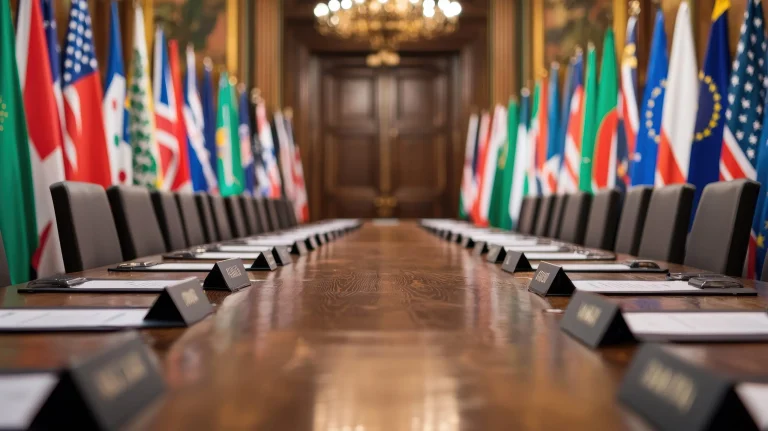

On 30 September 1661, the retinues of the French and Spanish ambassadors fought in the streets of London over whose coach would take precedence in a procession. Louis XIV demanded reparation, and Spain yielded. That quarrel over carriages explains why executives learn international protocol: a place in a procession, a seat at a table or a title spoken aloud is never merely personal when you stand for an institution.
Good intentions cannot stop such moments from being misread. Only an order agreed in advance can.
This article sets out what separates protocol from manners, what history shows about the cost of misread respect, and where global leaders meet protocol in practice. It is written by Cecilia Mirei Hakuba, founder and Principal of ICPA, which teaches international protocol as a discipline of procedure rather than a catalogue of etiquette.
Protocol Is Not Manners
Manners govern how individuals treat one another. Protocol governs how states and institutions treat one another. The two are routinely confused, and the confusion is costly.
Manners and etiquette belong to people and to cultures. They differ by family, region and era, and a gesture that signals warmth in one setting may signal familiarity in another. Edward T. Hall, who taught intercultural communication to American foreign service personnel in the 1950s, showed how much meaning travels in context rather than in words (Hall 1976; Rogers, Hart and Miike 2002). His distinction between high-context and low-context cultures describes tendencies of communication. It does not describe the individual in front of you.
Protocol answers a different question. When two states or two organisations meet, who is received first, who sits where, and how is each addressed? Personal taste cannot settle this, because taste differs, and the parties must be judged by a standard that does not depend on who is more powerful or more agreeable. Protocol therefore aims at fairness and consistency: one rule, fixed in advance, applied to everyone in the room.
The Vienna Convention on Diplomatic Relations of 1961 shows the principle at work. It sorts heads of mission into three classes and ranks those within a class by the date and time at which each took up his or her functions, a criterion that does not depend on any host’s preference (United Nations 1961, Articles 13, 14 and 16).
| Manners and etiquette | Protocol | |
|---|---|---|
| Operates between | Individuals | States and organisations |
| Source of authority | Custom, upbringing, culture | Agreed rules, treaties and established precedence |
| Varies with | Person, place and era | Applied consistently, whoever is present |
| Purpose | Graciousness | Fairness and consistency |
An executive receiving a delegation applies either personal taste or an established order. Only the second is protocol, and the difference is why executives learn international protocol rather than merely good manners. History shows what happens when the order is missing.
What History Teaches About Misread Respect
Protocol was built by failure. Each of its rules exists because a dispute once made it necessary.
In 1661 a new Swedish ambassador arrived in London, and the resident ambassadors sent their coaches to swell his procession. The French and Spanish ambassadors each claimed the higher place, and their retinues fought over it in the street (Jusserand 1892). The stakes were not vanity. An ambassador was understood to embody his sovereign, so his place in the line was a verdict on the king himself (Pepys Diary, n.d.). Louis XIV treated the affair accordingly, demanding reparation, and Spain conceded French precedence (Bouzidi, n.d.).
A general settlement took another century and a half. At the Congress of Vienna in 1815 the powers adopted a regulation on the rank of diplomatic agents. It recognised three classes of envoy and ranked agents within each class by the date of official notification of their arrival; a further agreement at Aix-la-Chapelle in 1818 added the intermediate class of minister resident (US Department of State 1868; 1920). Eileen Denza’s commentary on the 1961 Convention notes that the 1815 regulation greatly reduced disputes over precedence, and that the Convention restates its rules in modern terms (Denza 2008).
Misreading can also run the other way. The familiar story of the Macartney embassy to the Qianlong Emperor in 1793 holds that a refused ceremony doomed the mission. Macartney’s own proposal was reciprocal: he offered the full ceremony of the kowtow if an official of equal rank would perform it before the British king. Historians have since revised the popular account. James Hevia’s study of Chinese sources reads the encounter not as simple cultural misunderstanding but as a collision between two conceptions of sovereignty (Hevia 1995).
The lesson is not that one side lacked manners. It is that no agreed order stood between them, so each read the other’s gestures through its own. Executives now stand where those ambassadors stood, and the question is what they must know before they walk in.
Why Executives Learn International Protocol: Representing More Than Yourself
Abroad, an executive speaks for an organisation, and often for a nation’s commercial standing. Protocol is the discipline that lets global leaders do so, as diplomats do, without giving offence or ceding ground.
Three moments show where it applies.
Before the event. Every state keeps an order of precedence, and its protocol office applies it. In the United States, for example, the President establishes the order through the Office of the Chief of Protocol at the Department of State (US Department of State, 2 FAM 320). The executive’s task is to learn which order governs the occasion and to ask the host rather than assume.
At the door. Who greets whom, and who is received first, will be read as a statement of regard. Reading it correctly depends on knowing the order in advance, not on instinct or warmth.
At the table. At official events, seating follows precedence rather than familiarity, and a title is a statement of standing. Using the correct one tells your counterpart that you prepared.
An executive who knows the order does not need to improvise, and in international settings improvisation is where misreadings begin. Japan has its own long answer to the question of order, and it did not come from Europe.
Japan’s Own Tradition of Protocol
Protocol is not a European invention that Japan merely adopted. Japan developed its own codified system of ceremonial conduct, and later met Europe’s as a party with a tradition of its own.
The Ogasawara school traces its origin to Ogasawara Nagakiyo, who instructed Minamoto no Yoritomo in etiquette and mounted archery in the late twelfth century (Ogasawara-ryū, n.d.). Around 1380 a later head of the school, Ogasawara Nagahide, wrote the Sangi Itto, the first comprehensive text on etiquette (Lowry, n.d.). The Ogasawara were warriors, and their etiquette was no ornament: the school treats it as the foundation of its other disciplines (Lowry, n.d.; Ogasawara-ryū, n.d.). Form, in this tradition, was a discipline with a purpose.
Japan then met Europe’s system on the principle of reciprocity. In 1869 Iwakura Tomomi argued that sending envoys to Europe and America was above all a matter of diplomatic etiquette: Western powers had sent ministers to Japan, and decorum required Japan to send its own in return (JACAR, n.d.). The Iwakura Mission set sail from Yokohama in 1871, with courtesy calls on the treaty powers as the first of its three stated purposes, alongside treaty revision and a survey of foreign law (JACAR, n.d.). ICPA reads this as dual fluency: a nation learning another’s procedures while keeping its own.
ICPA teaches from that standpoint: principle first, form second.
Summary
- Protocol governs relations between states and institutions; manners govern individuals. Its purpose is fairness and consistency.
- History records the cost of misread respect: the street fight of 1661, the rules of 1815 and the revised story of 1793.
- An executive abroad represents more than themselves, and learns the order before entering the room.
That is why executives learn international protocol. Before your next international meeting, ask one question: whom do I represent in this room, and what order has already been agreed for it?
Learn International Protocol with ICPA
Protocol is learned, not inherited. ICPA offers two programmes for leaders who represent more than themselves.
- Global Business Protocol — The Global Authority: the foundation in international protocol for leaders who work across borders.
- Executive Protocol — The Executive Pinnacle: ICPA’s highest programme, for those who represent an organisation at the most senior level.
To speak with us first, request a briefing.
Related Reading
- What Is International Protocol?
- A Gentleman Is Made, Not Born
- The Trump–Emperor meeting and the protocol behind it
Sources
- Bouzidi, D. (n.d.) ‘Louis XIV to d’Embrun, 1 January 1662’ (Archives du ministère des Affaires étrangères, Paris, Correspondance politique, Espagne, vol. 41, ff. 103v–104). HistoryLab (Modernalia). Available at: https://historylab.es/?p=5032
- Denza, E. (2008) Diplomatic Law: Commentary on the Vienna Convention on Diplomatic Relations. 3rd edn. Oxford: Oxford University Press.
- Hall, E.T. (1976) Beyond Culture. Garden City, NY: Anchor Press/Doubleday.
- Hevia, J.L. (1995) Cherishing Men from Afar: Qing Guest Ritual and the Macartney Embassy of 1793. Durham, NC: Duke University Press.
- Japan Center for Asian Historical Records (JACAR) (n.d.) ‘Dispatch of Iwakura Mission’, Explanatory Column, Meiji at 150: Special Internet Exhibition — The Iwakura Mission. Available at: https://jacar.go.jp/english/exhibition/iwakura_en/column/index.html
- Jusserand, J.J. (1892) A French Ambassador at the Court of Charles the Second. London: T. Fisher Unwin.
- Lowry, D. (n.d.) ‘Bowing: Ojirei’. Koryu.com. Available at: https://koryu.com/library/dlowry16/
- Ogasawara-ryū (n.d.) ‘Ogasawara-ryū History’. Available at: https://ogasawara-ryu.gr.jp/english/about.html
- Pepys Diary (n.d.) ‘Godefroi d’Estrades’, Encyclopedia. Available at: https://www.pepysdiary.com/encyclopedia/3117/
- Rogers, E.M., Hart, W.B. and Miike, Y. (2002) ‘Edward T. Hall and the history of intercultural communication: the United States and Japan’, Keio Communication Review, 24, pp. 3–26.
- United Nations (1961) Vienna Convention on Diplomatic Relations, 18 April 1961, 500 UNTS 95, Articles 13, 14 and 16.
- US Department of State (1868) Papers Relating to the Foreign Relations of the United States, Part I. Available at: https://history.state.gov/historicaldocuments/frus1868p1/d227
- US Department of State (1920) Papers Relating to the Foreign Relations of the United States, Volume III.
- US Department of State (n.d.) Foreign Affairs Manual, 2 FAM 320: Precedence. Available at: https://fam.state.gov/FAM/02FAM/02FAM0320.html