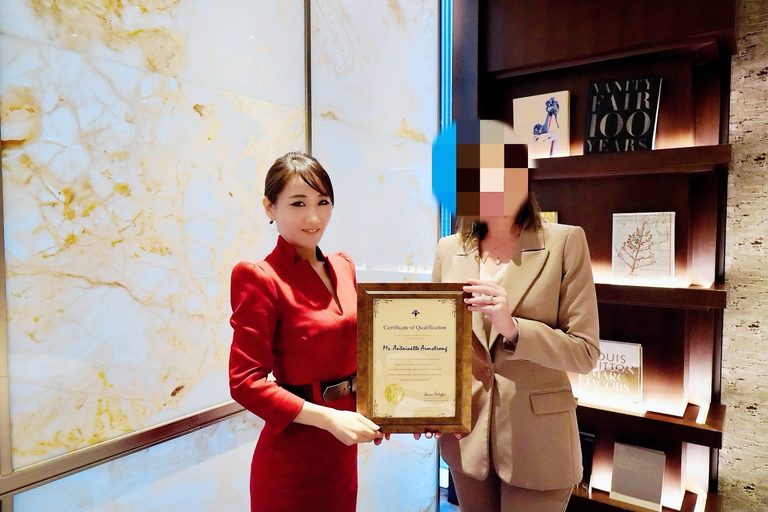


A traveller abroad turns to speak to someone and, before a single word is exchanged, senses a barrier that has nothing to do with vocabulary. This international protocol student testimonial comes from S.Y., a Japanese graduate of ICPA, who described that moment as walking through darkness while everyone else could see.
Her account matters well beyond Japan. It names, with unusual precision, what every executive meets when crossing into another culture: a wall built not of language, but of unwritten codes. What follows sets out what that wall is made of, why it yields to study rather than instinct, and how etiquette becomes the threshold of international protocol. Her words are read here by Cecilia Mirei Hakuba, Founder and Principal of ICPA, who trains government bodies and senior executives in protocol.
S.Y. Graduate, The Finishing Touch International Etiquette Course (now The Social Elegance) S.Y.’s words below are translated from the Japanese.
A Wall That Language Alone Cannot Explain
What held S.Y. back was never her English. It was the unspoken order that sits beneath every conversation.
My reason for taking the course was a sense of unease I had felt on every trip abroad, whenever I tried to speak with local people.
My language skills played a part, but before that there was something else, something like a wall.
Even allowing that the language barrier made things awkward, I felt as though I alone could not see — as if I were feeling my way through the dark.
Language rewards effort visibly; vocabulary can be counted and fluency measured. The codes that precede language are never formally taught. That is precisely why so many capable people attribute their discomfort abroad to language and look no further.
S.Y. looked further, and found that the wall had two distinct layers.
Two Layers: The Unwritten Rule and the Spirit Beneath It
The wall consists of two absences: not knowing the rules, and not understanding the spirit from which they arise.
I came to see that the wall was twofold. The first part was that I did not know the unwritten rules — the manners and etiquette rooted in Western culture and carried in the very air. The second was that I did not understand the spirit in which those rules are grounded.
Meeting people in that fog, anxious throughout, had made my communication all the more awkward.
Her conclusion is the one anthropology reached decades ago. In The Silent Language (1959), Edward T. Hall argued that much of culture is transmitted below the level of awareness, absorbed by its members without their being able to explain it. In Beyond Culture (1976), he distinguished high-context cultures, which entrust meaning to shared context, from low-context cultures, which make it explicit — and placed Japan firmly among the former.
The insight cuts both ways. A Japanese professional entering a Western drawing room meets the wall S.Y. describes. A Western executive entering a Japanese boardroom meets its mirror image, often without realising it is there.
| Layer | What is missing | What follows |
|---|---|---|
| Form | Knowledge of what to do | Hesitation; actions arrive a beat too late |
| Spirit | Understanding of why it is done | No footing when the unexpected occurs |
Knowledge of form alone produces rehearsed behaviour. Only when both layers are in place does conduct remain sound in situations no one has prepared for.
How, then, are both layers acquired? S.Y. located the answer in what she called her own clumsiness.
Not Instinct, but a Discipline
Refined conduct across cultures is not an inborn gift. It is a body of knowledge, written down and handed on.
There are people who get through on natural instinct. What I value is that, precisely because I was clumsy, I was able to learn from the beginning a knowledge with real provenance, rather than something vague.
Europe codified conduct early. In 1530 Erasmus published De civilitate morum puerilium, treating manners as something that could be taught from a book. Norbert Elias, in The Civilising Process (1939), traced how such manuals spread through court society and shaped the standards of behaviour Europe came to take for granted.
Japan followed a parallel and independent path. The Ogasawara school, custodian of warrior-class ceremonial, is traditionally held to have set its rites down in writing in the late fourteenth century, moving conduct from oral transmission to codified practice. Instinct fails when circumstances change; a discipline does not.
S.Y. was clear about whom she would recommend the course to:
I would of course recommend it to anyone who, like me, feels uneasy communicating with people from abroad — and equally to those already confident in Western etiquette, as a way of testing their skills.
Because men and women each have their own roles, knowing the content of the course will, at some point, prove an advantage to women and men alike.
In formal Western settings, roles are distinctly assigned — host and hostess, the one who escorts and the one escorted — so that an occasion runs with order and grace. Knowing those roles is, for anyone, a precondition of being trusted as part of the occasion.
Yet etiquette, however well learnt, is not the end of the road.
From Etiquette to International Protocol
S.Y.’s achievement places her at the threshold of international protocol.
Etiquette operates between individuals and changes its form from culture to culture. Protocol operates between nations and institutions, and exists to secure fairness and consistency.
The Congress of Vienna supplied the defining example. Its regulation of 19 March 1815 ranked diplomatic envoys not by the power of the states they represented, but by the date on which they took up their posts — ending centuries of quarrels over precedence. The principle survives today in Article 16 of the Vienna Convention on Diplomatic Relations (1961).
Japan brings its own protocol tradition to this table. The Iwakura Mission of 1871–73 visited the courts and state occasions of America and Europe, and its observations were recorded in meticulous detail in Kume Kunitake’s official chronicle. Japan went to learn Western ceremonial while carrying its own.
S.Y. made the same journey on a personal scale: she acquired Western etiquette and its underlying spirit without surrendering a Japanese sensibility. That dual fluency is exactly what international protocol demands.
A Wider View Brings Composure
Some weeks after completing the course, S.Y. shared a further reflection, summarised here by ICPA’s editors:
In a café, she overheard a young woman describe how her choice to eat plant-based food was treated as something remarkable by those around her, and how stifling she found everyday social life. The young woman’s observations were sharp and perceptive. S.Y. reflected that across the world, diversity in diet is entirely ordinary, and that anyone who knew this would hardly be unsettled by a passing remark. Often it is the most perceptive people who feel most constrained — and she hoped that this kind of learning might one day reach them.
At an international table, vegetarian and vegan guests are commonplace, as are those observing religious dietary law — kashrut in Judaism, halal in Islam. For a host, ascertaining these requirements in advance is not a courtesy left to individual thoughtfulness; it is elementary protocol.
Those who know the world’s standards are not shaken by the small judgements of the room. That composure is what S.Y. hoped others might find.
The final word belongs to the Principal, who guided her throughout.
A Note from the Principal
S.Y. is a person of rare depth of feeling, and she absorbed a great deal over the course of her studies.
When she began, she struck me as someone with a wealth of quiet charm who nonetheless held herself somewhat apart. Even so, it was clear that she wished to change something.
Watching her grow more polished with every session was a genuine joy. I am deeply grateful for her generous words.
Cecilia Mirei Hakuba Founder and Principal, ICPA
In Summary
- The unease felt abroad seldom stems from language; it arises from the unwritten codes that precede it.
- Those codes have two layers: the form of a rule, and the spirit that gives it meaning.
- Refined conduct is a discipline, codified in Europe and in Japan alike — and international protocol is its natural extension.
The next time an encounter abroad feels inexplicably awkward, resist blaming the language. Ask instead: what is the unwritten order of this room? That question is the first step through the wall.
The Course S.Y. Took — and What Lies Beyond
The course S.Y. completed is now offered as The Social Elegance, available through ICPA or TEA. → Discover The Social Elegance
For those ready to move from etiquette to the full discipline of international protocol:
- Global Business Protocol — The Global Authority: the foundational programme in the protocol of international business. → Explore the programme
- Executive Protocol — The Executive Pinnacle: ICPA’s highest programme, for those who engage with royalty, diplomacy and international institutions. → Explore the programme
Begin with an information session to determine the path best suited to you. → Register for an information session
Further Reading
- What Is International Protocol? Principles, Applications and Relevance
- Etiquette vs Manners: The Distinction That Defines True Global Leadership
- High-Context vs Low-Context: The Cultural Intelligence Every Negotiator Must Master
Sources
- Edward T. Hall, The Silent Language, Doubleday, 1959.
- Edward T. Hall, Beyond Culture, Anchor Press/Doubleday, 1976.
- Desiderius Erasmus, De civilitate morum puerilium, 1530.
- Norbert Elias, Über den Prozess der Zivilisation, 1939 (English edition: The Civilizing Process, Blackwell).
- Futaki Ken’ichi, Chūsei buke girei no kenkyū (Studies in Medieval Warrior Ceremonial), Yoshikawa Kōbunkan, 1985.
- Règlement sur le rang entre les agents diplomatiques, Congress of Vienna, 19 March 1815.
- Vienna Convention on Diplomatic Relations, 1961, Article 16.
- Kume Kunitake (ed.), Tokumei zenken taishi Bei-Ō kairan jikki, 1878 (English edition: The Iwakura Embassy 1871–73, Japan Documents).
- Leviticus 11 (kashrut); Qur’an 2:173 (halal).